Research
I’m most interested in how organisms interact, disperse, and evolve, and how these linked processes generate patterns of biodiversity. Questions that are especially fascinating to me:
- How do ecological outcomes change once we account for trait evolution?
- When do large-scale patterns emerge from connected processes operating at small spatial scales?
- How do species interactions and population processes shape molecular evolution?
To address these questions, I combine mathematical and statistical modeling, experiments, and genomics. Using a broad arrange of approaches also allows me to understand how ecology and evolution operate across scales, from molecules to metacommunities.
What maintains feedbacks between ecology and evolution?
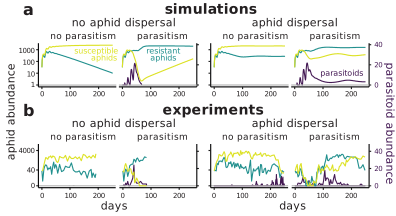
Feedbacks between evolutionary and ecological processes that occur because they operate on similar timescales is called eco-evo dynamics. For eco-evo dynamics to persist, the variation underlying both processes must be maintained, yet this fundamental component of eco-evo dynamics has received little attention. Pea aphids can evolve resistance to parasitoid wasps rapidly enough to affect the host–parasitoid dynamics. Through long-term lab experiments and simulations, we showed that moderate aphid dispersal among fields combined with non-random parasitoid dispersal cause both species coexistence and balancing selection. These two forms of dispersal together resulted in stable, persistent eco-evo dynamics (Nell et al., Science).
How does population ecology shape genome evolution?
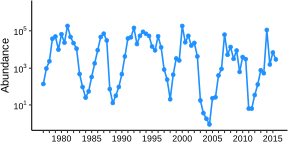
I am leveraging the extreme biology of chironomid midges (family Chironomidae, order Diptera) to understand how population ecology shapes genome evolution in natural populations. Chironomids are the most widely distributed group of freshwater insects and inhabit a vast range of habitats, many of which are inhospitable (e.g., Antarctica, hot springs). Yet we know little about the shared features underlying chironomids’ ability to tolerate extreme environments and how they achieve this despite especially compact genomes. In a recent paper, I described a number of candidate genes and gene families that may relate to chironomid tolerance to stress and show that their compact genomes are via reductions in repeat and non-coding elements (Nell et al. 2024, Genome Biology and Evolution). In a related project, I am using an example of extreme population dynamics to understand what happens to genetic diversity when populations experience frequent, short-duration bottlenecks. The population of Tanytarsus gracilentus at Lake Mývatn, Iceland, has irregular population fluctuations of about 5 orders of magnitude. In collaboration with Árni Einarsson (Director, Mývatn Research Station), I collected and sequenced T. gracilentus samples from Mývatn that spanned 24 years and 3 population crashes, and from 15 other lakes across northern Iceland. Our results so far are consistent with theoretical predictions about the effects of short-duration population crashes: population crashes cause a relative absence of rare alleles but have only moderate effects on overall nucleotide diversity. We have also identified a number of genes under selection due to midge abundance, mostly related to male fertility and responses to starvation. Further analyses will provide greater insights into how the complex population dynamics present in many real populations shapes genome-wide patterns of genetic diversity.
When do natural enemies change the impact of plant microbiota on insect-borne virus transmission?
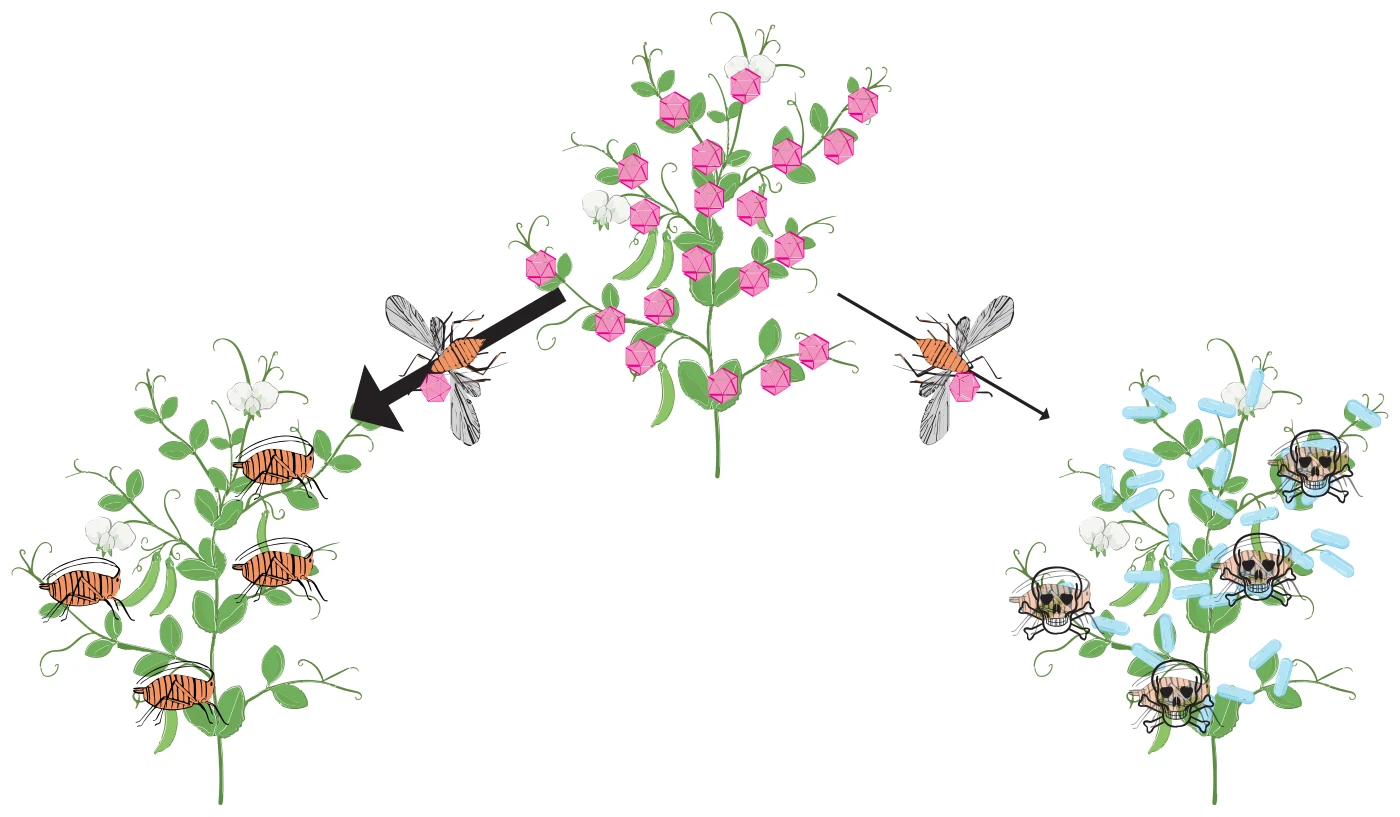
Individual hosts can be protected from disease vectors through their microbiota, but how those benefits scale up to the host population level is rarely obvious. Disease spread may be inhibited through reduced vector visitation or amplified as vectors redirect their attention to unprotected hosts. The outcome—suppression or escalation of disease outbreaks—is likely to be influenced by natural enemies that redistribute or suppress vector populations. The challenge of determining how these processes interact across scales is exemplified by pea aphids, major virus vectors in pea crops that are commonly managed using parasitoid wasps. Recent evidence suggests that epiphytic bacteria in the genus Pseudomonas can repel or kill pea aphids, yet whether Pseudomonas-mediated protection from aphids complements or undermines parasitoid-based vector control remains unknown. We developed a multi-scale mathematical model to investigate why Pseudomonas complements versus undermines biocontrol of aphid-vectored virus outbreaks. Because Pseudomonas-induced mortality leaves aphids patchily distributed, the effect of Pseudomonas on virus outbreaks depends most strongly on how well parasitoids track aphid densities. When parasitoids efficiently locate aphids, Pseudomonas inhibits virus outbreaks by reducing aphid densities. However, when parasitoids are less efficient, they often search unproductively for aphids on Pseudomonas-inhabited plants with few aphids, slowing parasitoid population growth. Reduced parasitism intensifies aphid crowding on Pseudomonas-free plants and boosts the production of winged aphids that accelerate viral spread. Counterintuitively, the more effective Pseudomonas is at killing aphids, the more strongly it generates spatial variability and promotes virus spread. Our results show how community context dictates whether individual microbiota protection slows or accelerates viral outbreaks at the population scale. (Nell et al. in review; preprint).
How can feedbacks between dispersal and community composition affect regional coexistence?
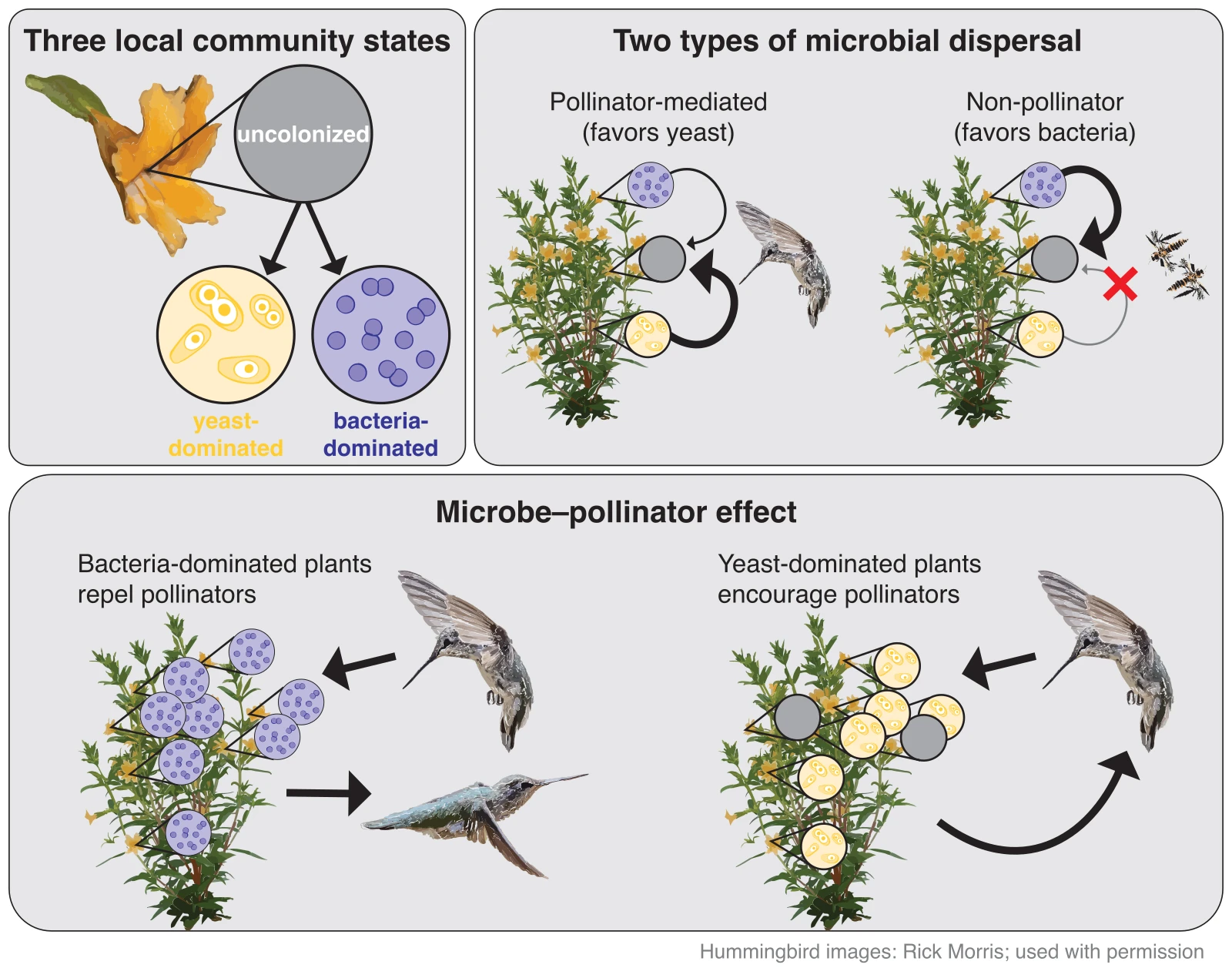
Non-random dispersal can promote regional coexistence despite local priority effects and negligible immigration. In the many cases of animal-mediated dispersal, hitchhikers can coexist regionally when animal vectors respond to environmental cues. However, this possibility has been poorly understood, particularly when local priority effects lead to history-dependent exclusion. We used a mathematical model of competitive communities of nectar microbes in sticky monkeyflower (Diplacus aurantiacus) to study how feedbacks between microbial communities and pollinator-mediated dispersal affect coexistence. Analysis of this model suggests that regional coexistence occurs only when microbial communities influence pollinator visit frequency. This microbe–pollinator feedback creates positive density-dependence at the plant scale that results in spatial niche partitioning across multiple plants. This partitioning facilitates mutual invasibility and stable regional coexistence of microbes. Our results highlight the importance of interactions between dispersal and community composition across scales in shaping patterns of species coexistence (Nell et al. in prep.; preprint).
Can trait coevolution among competitors promote coexistence?
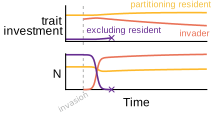
Coevolution among competitors can result in traits that promote niche partitioning and coexistence or traits that promote greater conflict and competitive exclusion. We used an eco-evolutionary model where competitors “invest” in coexistence- and exclusion-promoting traits to assess when trait coevolution should promote coexistence or exclusion. We found that communities should often contain both types of traits, but exclusion-promoting traits should more strongly influence trait coevolution community-wide. We also found that, despite being more influential, species invested relatively more in exclusion-promoting traits should be most vulnerable to exclusion by a new invader. This may make communities containing multiple species with exclusion-promoting traits transitory (Nell et al. in revision; preprint).